Milk Honey: The Modern Script Font for Elegant Design
There’s a particular challenge in finding a script font that feels both contemporary and timeless. Many swing too far into casual territory, while others feel overly formal and stiff. Milk Honey occupies that compelling middle ground—a modern script typeface with a romantic sensibility that manages to feel personal without sacrificing professionalism. It’s the kind of font that makes a designer pause mid-scroll, not because it shouts, but because it whispers with confidence.
Understanding the Character of Milk Honey
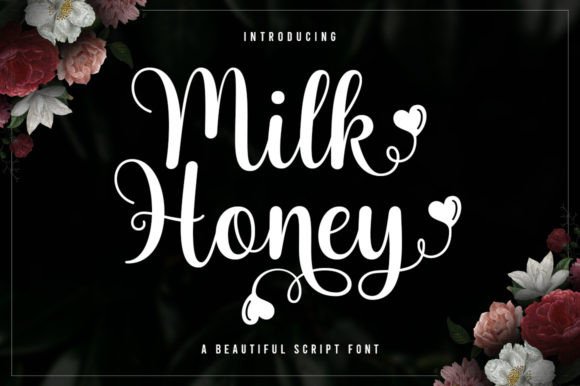
At its core, Milk Honey is a fluid, connected script with smooth, flowing letterforms. The strokes carry a natural rhythm, mimicking the organic movement of hand-lettering while maintaining the consistency and precision of a carefully crafted digital typeface. You’ll notice subtle variations in weight along each stroke—thicker where pressure would naturally build, tapering to delicate points at the ends of words. This gives the font an authentic, lived-in quality that flat, uniform scripts often lack.
The overall personality strikes a balance between warmth and sophistication. It doesn’t lean into the exaggerated flourishes of traditional calligraphy, nor does it adopt the raw, scratchy edge of a casual handwritten font. Instead, Milk Honey presents a polished, approachable elegance. The letter spacing feels generous, allowing each character room to breathe, which contributes to its readability even at smaller sizes. The x-height is moderate, and the ascenders and descenders have graceful curves that add visual interest without becoming distracting.
What makes this script font particularly versatile is its neutrality within its style category. It doesn’t carry strong cultural or era-specific connotations—it doesn’t scream “vintage” or “retro” or “bohemian.” This neutrality is a genuine asset for designers and brand strategists who need a typeface that can adapt across different contexts without imposing a specific mood that might clash with a project’s intent.
Where Milk Honey Truly Shines
The practical applications for Milk Honey extend well beyond wedding invitations, though it certainly excels there. Consider it for any project where you need to inject personality and human warmth into the typography without crossing into informality.
Brand Identity and Logo Design: For entrepreneurs and small business owners building a brand, Milk Honey works beautifully as a primary logotype for businesses in lifestyle, beauty, wellness, artisan food, boutique retail, or creative services. Paired with a clean sans serif font for body copy, it creates a brand identity that feels curated and intentional. I’ve seen it used effectively for bakery branding, where the flowing letterforms echo the organic quality of handcrafted goods, and for a skincare line where it conveyed natural elegance.
Editorial and Publishing: Magazine designers and bloggers can use Milk Honey for section headers, pull quotes, or article titles to break the monotony of serif and sans serif typography. It adds a layer of visual storytelling—a lifestyle blog using this font for its post titles immediately signals a certain aesthetic sensibility to readers. In editorial design, it pairs particularly well with a sturdy serif font for body text, creating a clear visual hierarchy that guides the reader’s eye.
Packaging and Product Design: Product labels, especially for artisanal or boutique goods, benefit enormously from a premium font like this. Whether it’s a honey jar (the name feels fitting), a candle label, or a cosmetic package, Milk Honey communicates craftsmanship and care. The font renders well in print at various sizes, maintaining its character whether it’s a small ingredient label or a prominent product name on a box.
Digital and Social Media: On social media graphics, Milk Honey can elevate a quote post, announcement, or promotional image. Its flowing style catches the eye in a feed dominated by geometric sans serifs and rigid layouts. For web design, it works best as a display font for hero sections, landing page headlines, or call-to-action statements—places where personality matters more than dense readability. Use it sparingly in digital contexts; a full paragraph set in any script font will fatigue readers quickly.
Personal and Commercial Projects: Wedding invitations remain a natural home for this typeface, but think broader: event programs, thank-you cards, certificate templates, menu designs for restaurants, and even tattoo-inspired art prints. Crafters and hobbyists will find it useful for personal projects like custom stationery, scrapbook elements, or DIY printables.
How Font Choice Shapes Audience Perception
Typography is never neutral. Every font carries associations, and those associations influence how audiences perceive your message before they’ve read a single word. Milk Honey communicates thoughtfulness, creativity, and a certain intimacy. When used appropriately, it signals that the creator has paid attention to details—that this isn’t a generic, template-driven project but something crafted with intention.
This perception directly impacts engagement. A wedding invitation set in a well-chosen script font like Milk Honey feels more personal than one set in a standard serif. A product label with thoughtful typography suggests higher quality, which can justify premium pricing. A social media graphic with distinctive lettering stops the scroll more effectively than one using system defaults. These are not theoretical benefits—they’re observable outcomes that designers and marketers encounter regularly.
However, font choice also affects readability and visual hierarchy, which are functional concerns. Milk Honey performs best at larger display sizes where its letterforms can be fully appreciated. At very small sizes, the connecting strokes and flowing details may become difficult to parse, particularly on low-resolution screens. This is common across script fonts and isn’t a flaw—it’s a characteristic that informs where and how you should deploy the typeface.
Practical Guidance for Working with Milk Honey
Before committing to any creative font for a project, take time to evaluate the fit. Set your key text—your business name, your headline, your invitation wording—in Milk Honey and view it in context. Does it match the tone you’re aiming for? Does it work at the sizes you’ll need? Print a sample if the project is print-based; screen rendering can differ significantly from ink on paper.
Font pairing is where many projects succeed or struggle. Milk Honey pairs well with clean, geometric sans serif fonts for a modern contrast, or with classic serif typefaces for a more refined combination. Avoid pairing it with other decorative or handwritten fonts—competing personalities create visual noise. A good rule: if your headline is expressive, let your body text be quiet, and vice versa.
Check what’s included with the font package. Quality script fonts often come with stylistic alternates, ligatures, and swash variations that give you additional design flexibility. These alternate characters can help you customize the look for specific words or create more natural-looking connections between letters.
Finally, understand the licensing. If you’re using Milk Honey for commercial work—client projects, products for sale, business branding—make sure your license covers that use. Most premium font foundries offer clear licensing terms, and respecting those terms is both a legal obligation and a way of supporting the designers who create the design assets we rely on.
Typography is one of the most powerful tools in a designer’s toolkit, and choosing the right typeface for a project is a decision that deserves careful thought. Milk Honey won’t be the right fit for every project, but where it fits, it brings a distinctive warmth and sophistication that’s difficult to replicate with other font categories. That combination of modern structure and romantic fluidity makes it a valuable addition to any designer’s library—a script font that feels both current and enduring.